A Key Above Every Key
How one key came to override all the others

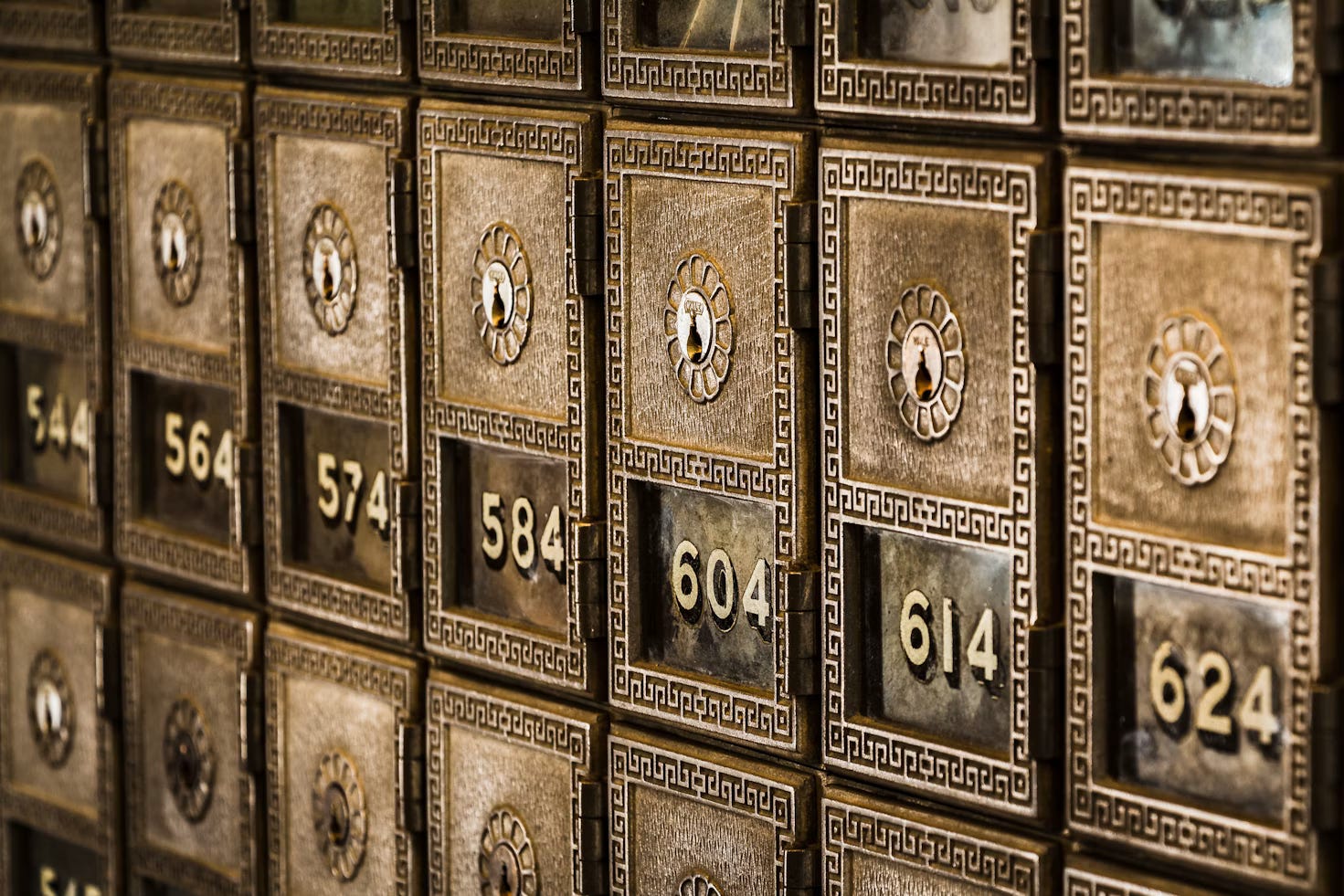
Every box, its own lock. Now one key opens them all. — Tim Evans / Unsplash
The Permission Society · Part III
On the fourth of May, a company posted a press release.
It was a few hundred words — a corporate notice that scrolls past a thousand inboxes, read by almost no one. Something about a working group, and a launch planned for later in the year.
The company was DTCC. You have probably never thought about it. But it is the quiet center of American finance — the room where the records are kept for nearly every share and bond in the country.
If you own a stock, you do not really hold it. A firm called Cede & Co. holds it, on behalf of a chain of middlemen, on behalf of you. DTCC is where that ledger lives. It keeps custody of more than a hundred and fourteen trillion dollars, and settles nearly four quadrillion in transactions every year.
That is the institution that posted the press release.
And what it announced, beneath the language of modernization, was this: the most liquid assets in America — the largest stocks, the index funds, the Treasury bonds — will be turned into tokens that can be reversed, burned, or stopped from moving, from the center.
No hearing, no vote in Congress, no public rule that anyone could comment on. Just a vendor notice, posted on a Monday, fitting a master key over the most liquid securities in the country.
This is the third piece in this series, and it is the one I most want you to sit with. Because it is the least dramatic, and the most important.
* * *
The first essay was about the token — the thing you own that is really an entry, with an author. The second was about the money — the dollar that asks permission before it moves. This one goes underneath both, to the machine itself.
* * *
The builders deserve a real hearing. Most of their case is right, so let me make it as strongly as I can.
This is not a crypto stunt. It is not a memecoin. The institutions behind it are the most serious in finance: BlackRock, J.P. Morgan, Citi, Goldman, Schwab, the clearing firms, the exchanges. Fifty of them, in a working group. A sitting SEC commissioner welcomed it, calling it a step toward moving markets onchain.
And their central promise is true. Tokenizing your shares does not strip your rights. Under the law, you keep what you had — the dividend, the vote, the claim in a bankruptcy. The securities stay registered to Cede & Co., exactly as before.
The reason is real too. The old plumbing is slow — trades take a full day, billions in collateral trapped in the wait. The new rails settle in seconds, around the clock. That is not a toy. It is a large, real efficiency, and the people chasing it are not fools.
I spent forty years inside this system. I know the people who build these things. They are not cynics. They are engineers who look at a slow, breakable machine and want to make it fast and sound. That instinct is honest, and the problem is real. Hold that, because the rest of this depends on you believing I mean it.
* * *
To understand what is changing, you have to see how little you already hold.
Since the paperwork crisis of the late nineteen-sixties — when Wall Street drowned in physical certificates and firms failed under the weight — the paper was locked in one vault, and only the records moved. That vault is the Depository Trust Company. The shares were registered under a single name, Cede & Co., a nominee that holds them for everyone.
So you have not really held your shares in fifty years. You hold a claim against your broker, who holds a claim against DTC. What you call ownership is already a record in someone else’s book. Tokenization is not the first abstraction; it is the next one — another layer, another keyholder, between you and the thing itself.
* * *
Now the turn.
The defenders say: same rights. They are correct.
But ownership in the real world is not only a matter of legal right. It is also a matter of friction.
In the old system, freezing your assets took work. A court order, served on a broker, passed down a chain of people — each a step where it could be questioned or refused. That friction was a protection. It meant no one could reach your money instantly, or without someone else knowing.
The new system removes the friction.
The legal right stays on top, untouched. Underneath it sits a control surface that did not exist before. The freeze that used to take a court and a week becomes a line of code that runs in a second.
And there is no one to argue with. The old freeze had a human in it somewhere — a clerk, a judge, someone who could be petitioned. A frozen token has no one. Only the key, whoever holds it, and the silence on the far side of a function call.
Same rights, on paper. A master key, underneath. Both true at once. That is the catch.
* * *
I am not guessing. This is in the federal document behind it — the no-action letter the SEC’s staff issued to DTC on the eleventh of December, 2025. You can read it. I have.
Start with what a key is supposed to mean.
The whole promise of digital ownership rests on one idea. Each asset has a key — a long, secret string only the owner holds. Hold the key, and the asset is yours; no one can move it without you. The industry built a slogan on it: your keys, your coins. That was the entire point.
Now read what the federal document gives DTC.
It grants DTC a “root wallet” on each blockchain, with a key that can “convert, transfer, mint, or burn” the tokens — and here is the line that matters — “even without the private key for the Registered Wallet.”
A key that works without your key. A key above every other key.
The one promise — that only the holder can move the asset — is quietly cancelled. The institution can move or destroy the token whether you agree or not. There is a master key now, and the institution keeps it.
And note where it sits. Not at your brokerage app, but a layer above — at the depository, where your broker’s entitlement is recorded. The layer you can never reach is the one with the override.
I am not surprised that it exists. I am only surprised that they wrote it down.
I have spent years studying how control is built into systems — in the defense and security world, and across the markets where I spent my career. Somewhere in every system that matters, its makers leave a way in. A master switch at the center, justified by safety, held for the day they decide they need it. They almost never put it in writing. Here, for once, it is in plain federal text. The technology changes. The master key does not.
The tokens can travel only between wallets the institution has approved. Each of those wallets is screened against the sanctions list before it can hold anything. And when the institution decides a transfer must be undone — the document has a name for it, a “Condition Requiring Reversal” — the root key reaches in and reverses it.
There is one more line you should know. The official record of who owns what does not live on the blockchain. It lives off-chain, in a system called LedgerScan. The letter says it directly: “LedgerScan’s record would constitute DTC’s official books and records.”
Sit with that. The public ledger, the one everyone can see, is not the truth. The truth is a private database the institution keeps. If the two ever disagree, the private one wins.
So the blockchain here is not the open, tamper-proof thing it was sold as. It is a fast messaging layer beneath a central ledger, governed by a master key. Every freedom the technology promised has been quietly removed. The control it makes possible was kept, just as quietly.
* * *
And this is not hypothetical. The power to freeze ordinary people has already been used, in sober democracies, more than once.
In 2013, Cyprus ran short of money. Over a single weekend the government reached into private bank accounts and took a share of what it found — close to half, for the largest depositors at one bank. People woke to find their savings levied and the cash machines capped — only a deal struck while they slept.
In 2022, Canada invoked emergency powers and let banks freeze accounts with no court order. Around two hundred were frozen, for people tied to a protest the government had declared illegal. Whatever you thought of the protest, notice the mechanism. No charge, no conviction — a name on a list, and the money stopped.
That was the slow version — account by account, bank by bank. What the letter describes is the fast version, built into the asset itself.
And the stakes are not only America’s. Foreign investors hold some nine trillion dollars in US Treasuries and twenty trillion in American stocks; DTC holds securities from over a hundred and fifty countries. A growing share of the world’s safe assets is being moved behind one key. That is not a charge against America, but a measure of how much rests on getting the checks right.
* * *
Now consider how it was done.
A change this large — rewiring the ownership records of the country — would normally need a formal rule. A public filing, open for comment. Months in daylight, where anyone could object.
It did not go that way. It went through a no-action letter — the staff saying they will not recommend enforcement, so long as DTC behaves as promised. No public process. None of the rule changes that normally govern critical market infrastructure. And it is temporary: it expires three years after launch, and the staff can revoke it whenever they choose. The people whose ownership was re-plumbed were never asked, because the path chosen did not require it.
And the intent was not sinister. This was no back-room conspiracy. It answers a policy directive — a 2025 federal working-group report urging regulators to make room for exactly this. It is policy, pursued in the open, by people who believe it is progress. And it is not the work of one party. Administrations of every stripe reach for power this way, and each builds tools the next inherits.
But look at what it produced. The most consequential change to American financial plumbing in a generation, installed with no public vote, on a temporary permission, by an agency’s staff. The road it took around the public should give you pause.
* * *
And this power has real work to do. Criminals launder money. Networks finance violence. Sanctioned regimes hide their wealth. A system that can freeze a thief or a terrorist’s account in seconds is not a dystopia. It is a legitimate tool, and I would not wish it away.
A century ago, watching a new technology meet old power, Justice Brandeis named the danger. “The greatest dangers to liberty,” he wrote, “lurk in insidious encroachment by men of zeal, well-meaning but without understanding.” Not villains. Men of zeal, building well. That is what this is.
So the question is never whether the power should exist. It is where it should sit, how fast it should act, and what stands in its way.
* * *
So here is where I land, after all the fairness I can give it.
The rights are intact, and the efficiency is real. And I still think this is a grave mistake — one I believe we will come to regret.
We have taken the records of nearly all American wealth and fitted them with a single master key. We did it for good reasons — to settle faster, to stop fraud, to obey the law when it knocked. Every one of those reasons is sound. Not one of them changes what was built.
Every other great power in a free society is checked. The president by Congress, Congress by the courts, the courts by the people. We built a country on the idea that no hand should hold too much, unwatched. This power slipped past that idea. And the brakes that restrain everything else — a vote, a hearing, a court, an appeal — were left off.
Because a master key does not care why it was made. It knows only what it can do, and whose hand it answers to.
* * *
Let me say exactly what this proves, and what it does not.
It does not mean there is a plot. The motive is public and rational — the old system is slow, and Wall Street wants it fixed.
Nor does it mean your stocks are being seized, or screened for your politics, or tied to a social score. There is no evidence of any of that. The checks today are sanctions and identity. Nothing more.
The key is not silent, either. Each time the institution uses it, it must report that use to the regulators. For now, it is watched.
What it means is narrower, and I think it is enough. The machinery to freeze, reverse, and erase any of these assets — instantly, from the center, by one hand — has now been built, approved, and is being switched on, at the root of American finance. It was built to stop fraud. It will work on anything. It waits only for a reason.
And one day it will not be someone else. The day the key turns on your account, you will not be a criminal or a dissident. You will be a name that reached a list you never saw, for a reason no one is required to explain. By the time you think to ask, the money will already be still.
* * *
So go back to the press release — the boring one, the few hundred words almost no one read.
That is how it happens. Not with a crisis, not with a vote, but with a Monday notice about a software upgrade, and a public trained to scroll past exactly this.
The most liquid wealth in America, and much of the world’s savings parked beside it, now has a master key. You will never see it on your screen. It was cut for the best of reasons, and it will outlast every one of them.
The question is not whether the key will be used well. For now, it probably will be.
The question is the one to ask while the permission is still temporary and the rule has not yet set. Who holds the hand that turns it — and what will we do on the day the reason to turn it changes?
I'm increasingly aware of LLMey patterns on almost every piece of content that I read. it is becoming sickening. I know the ideas are yours, but the question is not if the ideas are yours, but if they will shine through after being molded into a pattern.
I can play the pattern too. I hope you may write at least a few paragraphs on your own, otherwise, no matter how good the ideas are, people will start losing interest. All it is written in the same obnoxious manner, like a know it all, with phrases borrowed from reddit, and the exact same structure. It loses power and shine, and steals the pleasure of reading with care, something written with the personal care one, as a reader, should demand.