The Honest Pitch
What a token is, before we argue about it
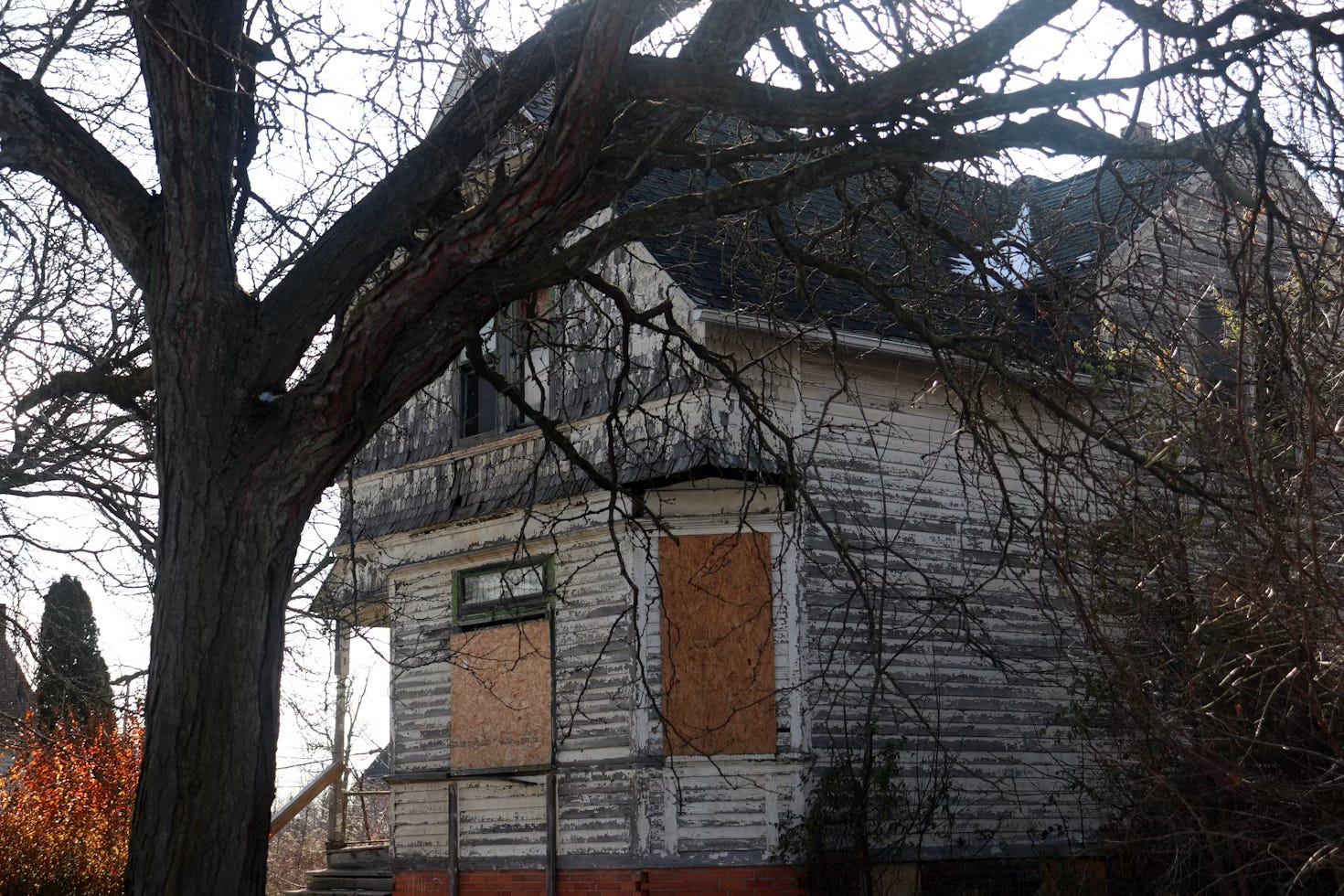
A boarded house, owned now by people who will never see it. — Liam Rearick / Unsplash
The Permission Society · Part I
Somewhere in Europe, at three in the morning, a phone lights up.
Its owner has earned a few cents on a house in Detroit. The number in his app has ticked up while he slept.
At that same hour, in that same house, Cornell Dorris is awake and standing in water. It is black, and it comes up through the basement floor when it rains. Tonight it is raining.
Dorris does not own the house. About sixteen thousand people do, scattered across the world. Sometime around 2023 the building was cut into pieces and sold, fifty dollars a slice, as digital tokens on a blockchain. The sleeping man owns one of those slices. He has never seen the basement. He has never met Dorris, who has lived here for ten years, cooks for a living, and knows the place the way you know a house you have slept in for a decade.
A line in a ledger connects them. Nothing else does.
The brochure is real. So is the basement. Both at once. That is the problem this series is about.
Let me give you the ending now, so you can watch me earn it. The thing the sleeping man believes he owns, he holds by permission. The deed to that house sits in a county office in Michigan, and his name is nowhere on it. He owns an entry in a ledger. An entry has an author. And the author is not him.
Hold that. We will come back to it from the basement.
* * *
First, what the thing actually is.
A token is a digital stand-in for something you own. A share. A bond. A dollar. A bar of gold. A house.
The thing itself does not move. The gold stays in the vault. The house stays on its lot. What moves is the record of who owns it. The record goes onto a blockchain. A shared ledger, read by many at once, instead of a private one kept in the dark by a single firm.
That is all a token is, at the bottom of it. A line that says this is yours.
There is a fork here worth marking, because it matters later. Some tokens are the thing itself. Some are a claim on a thing that someone else holds for you. And some are neither. They only copy a price, the way a photograph copies a face. On the screen, all three look the same. The sameness is the point.
It sounds like a filing change. A faster database. By the end of this you will see why it is not.
* * *
Now the other side, in full, and without a sneer.
I have spent my life around capital and the machines that move it. So I know what the old plumbing costs. It is slow. It is dear. It drops things.
Buy a share of stock today and you do not get the share. You get an entry at your broker. Your broker holds an entry at a clearing firm. The clearing firm holds an entry at one company that keeps nearly all the stock in the country under a single name. The trade takes a day to settle. Sometimes two. Behind the screen, people spend their working lives checking one list against another.
Tokenization promises to fold that whole tower into a single page. One ledger. Settlement in seconds. A market that never sleeps.
This is not a dream. Pieces of it already run.
On the sixth of May, 2026, a block of United States Treasury bills was redeemed across a public blockchain. The asset cleared in under five seconds. The cash ran through a bank network and reached an account in Singapore minutes later. The clearinghouses were closed. The money did not care.
Five seconds. Hold that against the basement. In Detroit the water takes all night to drain. In Singapore the safest asset on earth moved before you could finish reading this sentence.
That speed is no trick, and it is worth wanting. So are the savings, and they have been measured, not guessed. Hong Kong’s central bank studied tokenized bonds against ordinary ones. The tokenized bonds traded tighter. Investors took a little less yield to hold them. The cost of issuing fell by almost a quarter. Those are basis points, and basis points are real money to the people who pay them.
The largest money manager on earth has staked its name on this. Larry Fink runs BlackRock. He has said it out loud, from the stage, more than once. Every stock, every bond, on one general ledger. He is not a man in a basement with a theory. He holds the retirement savings of teachers and firefighters in his hands. When he says it, the room leans in.
And there is the fairness case, which is the one I cannot wave away.
Half the planet carries a bank in its pocket now. A phone. Many of those people cannot open a brokerage account. The old system was not built for them. A token does not ask where they live. If they have a wallet, they can hold a slice of a bond issued by a government an ocean away. For a young man in Lagos, that is a door that was bolted his whole life.
So let me say it, and mean it. The people building this are not villains. The benefits are not lies. If this were only a swindle, it would be easy to dismiss, and I would not be writing about it. It is not only a swindle. That is exactly why it matters.
This is the first room. I have sat in it. Let me tell you about a time I did.
I will not name the city. It does not matter. There have been several, and they are the same room.
A young man stood at the front. Clever. Sincere, which is the part people forget to fear. He believed every word. He had a diagram, and the diagram was beautiful. Boxes, arrows, and at the center one clean ledger where everything met.
He said the word frictionless. He said it the way a priest says grace.
I watched the table. Men I had known for thirty years. Careful men. They were nodding. So was I.
Because it was true. That is what I need you to understand. Every line of it was true. Faster, cheaper, open to the poor, safer even, in the narrow way he meant it. I had spent forty years pushing money through pipes that leaked. Here was a man with pipes that did not.
I wanted it. I will say that plainly, because there is no use in any of this otherwise. I did not sit there as a prophet seeing a cage. I sat there as a buyer, wanting the thing on the screen.
Then he reached the slide about compliance. The keys. He said the issuer would keep certain controls. For safety. For recovery. For the law. He said it quickly, in a smaller font, and moved on. No one asked. I did not ask.
I have thought about that silence for a long time.
We were not deceived. He hid nothing. The power to reach into the asset and switch it off was right there, in the smaller font, and we let our eyes pass over it, because the rest of the picture was so clean, and we wanted the clean picture.
That is how it comes. Not with a gun. With a beautiful diagram, a smaller font, and a room of careful men who want the convenience and do not ask about the key.
I was one of them. That is the part I cannot set down.
* * *
Now the turn.
Go back to the deed.
When I sold my land in Montana, what passed was a piece of paper. It sat in a county office. It said what it said. No one could rewrite it from a thousand miles away. To take it, a person would have had to stand in that office, or send a sheriff, or win in a court of law. The paper was slow. That slowness was its whole virtue.
A token is not a piece of paper. A token is an entry. An entry has an author. The author holds a key. And the key can reach in.
This is the seam. It is easy to miss, because the pitch is built to slide you past it.
Here is what I mean.
When a firm like BlackRock puts a fund on a blockchain, the token for your share is not a wild, free coin. It is built to be governed. It has to be.
The code has a privileged role written into it. Call it the agent. The agent holds a master key. With that key, the agent can freeze your token where it sits. Move it out of your wallet, with no signature from you. Destroy it, and mint a fresh one for someone else.
This is not a flaw. It is the feature. It is written down, in the open, in the standards these tokens are built on. One of the most common says it without blushing. The issuer always keeps control. Mint, burn, block, or force transfers, at any time.
At any time.
I am not describing a break-in. I am describing the blueprint. The power to reach into your holding is not a defect the engineers missed. It is the product they shipped.
And there is a reason for it. A decent one. Lose your key, and someone must be able to give your money back. A court orders a freeze, and someone must obey. A thief drains you, and someone must claw it back.
Each of those is a service. Each is the same power, turned a different way.
The power to give your money back is the power to take it away. There is no version of the first without the second.
I know how that sounds. I also know I would have wanted that recovery key the morning I lost my own. I would have called it protection. I would have been right. That is the trap. The thing that saves you is the thing that holds you.
* * *
And here is the part that was true long before the blockchain arrived.
You think you own your shares. You do not. Not the way you own a chair in your kitchen.
Under the law, what you hold is a claim. A claim against your broker. Your broker holds a claim against the firm above it. At the very top sits one name, holding almost all the country’s stock for everyone at once.
A claim against a claim against a claim. A hall of mirrors. Your name is in none of them.
You have been a tenant in another firm’s ledger for fifty years. You simply never had to look.
Tokenization did not invent this. It inherited it. Then it bolted a faster, finer set of controls on top. The token does not free you from the middleman. It hands the middleman a sharper tool.
Faster to settle. Easier to audit. Also easier to freeze. The same upgrade does all three at once, and you do not get to choose which one you are buying.
* * *
There is a second move, quieter than the first.
Some tokens hold the real thing. Behind them sits an actual share, carrying the rights a share carries. Others hold nothing of the kind. They track a price and grant you nothing underneath. No vote. No dividend. No claim on the company at all.
In January of 2026, the staff of the Securities and Exchange Commission wrote the difference down. Some tokens carry the rights beneath them. Others may or may not. In that second case, what you own is a promise from whoever minted the token. It runs to the middleman, not to the company.
Europe’s market regulator said it more bluntly. A tokenized stock can follow the share price and give you none of the ownership. The danger, it said, is that people will not understand. They believe they bought the thing. They bought a picture of it. The world’s stock exchanges, no friends of crypto, sent the same warning in 2025, and asked the plain question no one could answer. If the platform fails, what does the holder actually own?
* * *
Now back to the house.
This is where the brochure tears open, and it tears along the line I drew at the start.
American law will not let you sell land with a token. It cannot be done, and the wall is deliberate. Land passes by deed, recorded in a county office, and the law guards that road on purpose. There is a doctrine, old as English law, that says you cannot invent a new kind of property and turn it loose in the world. The forms are fixed. The registry is the truth.
So the people who tokenize houses do something clever. They do not tokenize the house. They cannot. They put the house inside a company. A small shell, one for each property. Then they sell you tokens in the shell.
You do not own a piece of the house. You own a piece of the company that owns the house. Your name is not on the deed. It never was.
When it works, you cannot feel the gap. The rent lands. The number rises. You feel like an owner, and the feeling is enough.
When it breaks, the gap is the only thing left.
In Detroit, it broke. The city sued the company that sold those tokens. It named the two founders and a hundred and sixty-five of their shells in a single filing. It said hundreds of the houses were unsafe. Mold. No heat. No certificate fit to be lived in. The largest suit of its kind the city had ever filed.
A judge stepped in. She turned the rent away from the wallets and into an escrow account, to be spent on repairs. The sleeping man stopped being paid. The water in the basement got a budget.
I will be careful here, because it would be easy to overreach, and I will not.
What happened in Detroit is not the dark future I am warning about. It is something older and plainer. Bad landlording. Slumlords were here long before blockchains. You do not need a token to let a roof rot.
But Detroit shows the seam, lit from the inside. The investors believed they owned homes. They owned shares in shells. The ledger said one thing. The deed said another. When the two disagreed, the people in the houses paid for it, and so did the people in the wallets.
The token felt like ownership. It was a claim, sitting on a claim, sitting on a deed that none of the owners ever touched.
As for the company, it said it would sell the Detroit houses and move on. New tokens. New buildings. Colombia next, then Panama. The ledger rolls forward. The basement stays where it is.
* * *
Now some cold numbers, because the talk runs hot and the truth is smaller, and stranger, than either side will tell you.
Set the digital dollars aside for a moment. The whole world of tokenized real assets was worth about six billion dollars at the start of 2025. By the middle of 2026, around thirty billion. Fast growth. Also tiny. The American stock market alone runs to the tens of trillions.
And most of that thirty billion is not houses or art. It is the unglamorous end of finance. Short-term government debt. Private credit. Some gold. The standardized stuff moved first, because that is where the back-office savings are real.
The digital dollars are the bigger story. Stablecoins are now worth around three hundred billion. The money layer dwarfs the asset layer. Remember that. Money is the rail everything else rides on, and money is the first thing they came for. That is the next essay.
And the small investor’s dream, the slice of a house? One study looked at fifty-eight tokenized rental homes. Each had, on average, two hundred and fifty-four owners.
Two hundred and fifty-four people to a single house. None on the deed. None in the basement.
* * *
So let me be exact about what this proves. And about what it does not.
It proves the old plumbing can be replaced, and that the new version is faster and cheaper at what it is built for. Cash. Collateral. Government debt. That is here, and it is working.
It proves idle money can be made to work around the clock. A true gain. The people chasing it are not fools.
It does not prove that tokenizing a thing makes anyone want it. A house nobody wanted is still a house nobody wants, only now in slices. Even the builders admit it. You cannot conjure a buyer with code.
It does not prove that anyone slipped the law. The regulators did not vanish. They wrote themselves into the system. There is even an argument from inside the government that the slow settlement everyone wants to kill is a feature, not a fault. The daily netting it allows cancels about ninety-eight cents of every dollar before any money moves. Speed is never free. It only hides the cost.
And it does not prove the small investor got what he was sold. Often he got a shadow. A price without a vote. A yield without a deed. A landlord’s cut with none of a landlord’s reach.
* * *
So here is where this leaves us.
Take the speed. Take the convenience. They are worth wanting, and you will want them. I am not telling you to refuse. I am telling you to notice the trade. What you used to hold outright, you now hold by permission. The deed in the drawer answered to no one. The token answers to whoever holds the key.
A deed is a fact. A token is an entry. An entry can be edited.
Dostoevsky drew the shape of this a long time ago. His Grand Inquisitor tells Christ that men will lay their freedom at his feet for bread, and thank him for taking the weight of it away. He understood us better than we like. No one will seize what we own. We will hand it across the counter ourselves, for the speed, for a few cents arriving in the night, and we will be grateful for the service.
Go back, one last time, to the man in Europe. He is asleep, a few cents richer, on a house he will never see. And to Cornell Dorris, awake in the water, in a house that strangers on the far side of the world own and cannot help him fix.
One line in a ledger connects them. Someone, somewhere, can change that line.
So before we go further, ask the small question first. Not whether to use this. You will. We all will.
Ask who can reach in.
Nazem Alkudsi
“The thing that saves you is the thing that holds you.” True in so many ways.